
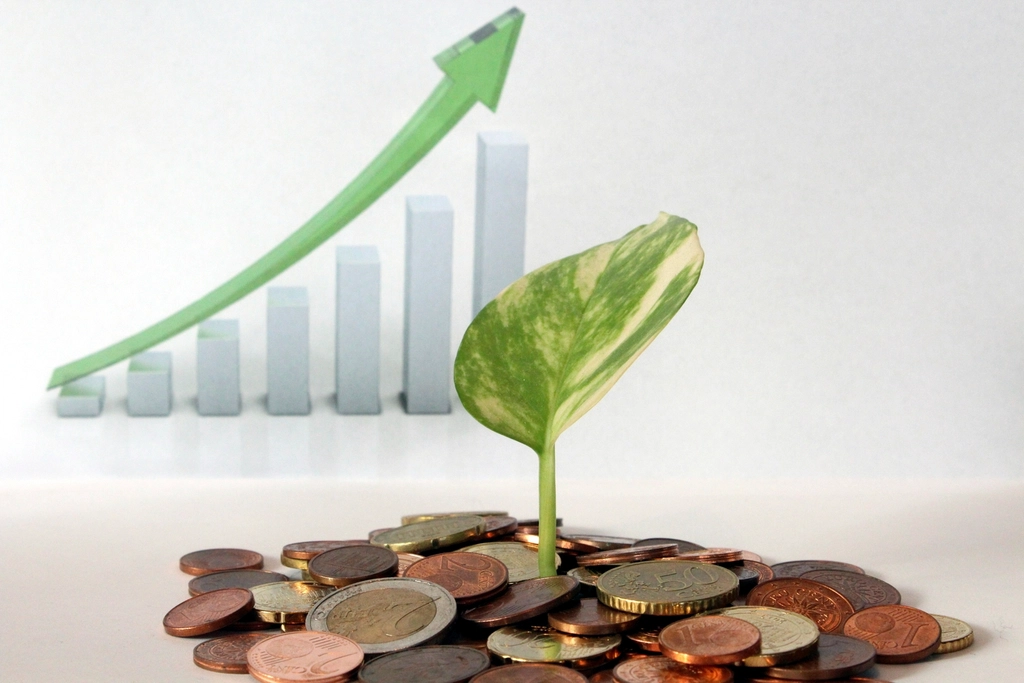
Albert Einstein supposedly called compound interest the eighth wonder of the world, adding that "those who understand it, earn it; those who don't, pay it." Whether or not he actually said it, the idea is dead-on. Compound interest is the quiet engine that turns ordinary paychecks into seven-figure retirement accounts, and it rewards one thing above all others: time.
This guide breaks down exactly how compounding works, the difference between simple and compound interest, the handy Rule of 72 for estimating how fast money doubles, and a fully worked dollar example showing why a 25-year-old who starts early can finish ahead of a 35-year-old who contributes far more. By the end you'll understand why "start now" beats "start big."
What Compound Interest Actually Is
Compound interest is simple to define but powerful in practice: it's interest earned on your interest. When you invest money, you earn a return. The next period, you earn a return not just on your original deposit but also on the returns you already collected. Those returns then earn their own returns, and the snowball keeps rolling, growing faster and faster the longer you leave it alone.
Picture a snowball rolling downhill. At the top it's small and picks up only a little snow. But as it grows, each new roll adds a thicker layer because the surface is bigger. Your money behaves the same way. The first few years feel slow and almost discouraging. The later years are explosive, because by then your gains are generating gains of their own.
The catch is that compounding needs time to do its heavy lifting. That's why the single most valuable asset a young investor has isn't a big salary or a hot stock pick. It's the decades stretching out ahead of them.
Simple vs. Compound Interest
To appreciate compounding, it helps to compare it with its weaker cousin, simple interest. With simple interest, you earn a return only on your original principal, never on the interest you've already earned. The interest is calculated the same way every year and never grows.
Say you invest $10,000 at a 7% annual return and leave it for 30 years. Here's how the two approaches diverge:
| Year | Simple Interest Balance | Compound Interest Balance |
|---|---|---|
| Start | $10,000 | $10,000 |
| 10 | $17,000 | $19,672 |
| 20 | $24,000 | $38,697 |
| 30 | $31,000 | $76,123 |
Both started with the same $10,000 at the same 7% rate. After 30 years, simple interest produced $31,000, while compound interest produced roughly $76,123, nearly two and a half times as much. The only difference is that compounding let the interest earn interest. The longer the time horizon, the wider that gap becomes. Run your own comparison with our Compound Interest Calculator to see the curve bend upward over time.
The Rule of 72: A Mental Shortcut
You don't need a spreadsheet to estimate how powerful compounding is. The Rule of 72 is a quick mental trick: divide 72 by your annual interest rate to estimate how many years it takes your money to double.
- At a 6% return, your money doubles in about 72 ÷ 6 = 12 years.
- At an 8% return, it doubles in about 72 ÷ 8 = 9 years.
- At a 10% return, it doubles in about 72 ÷ 10 = 7.2 years.
Flip it around and the rule reveals how doublings stack up over a long career. Suppose you invest $10,000 at age 25 and earn an 8% average return. It doubles roughly every 9 years:
- Age 25: $10,000
- Age 34: $20,000 (1 doubling)
- Age 43: $40,000 (2 doublings)
- Age 52: $80,000 (3 doublings)
- Age 61: $160,000 (4 doublings)
That same $10,000 grew sixteenfold without you adding a dime. The Rule of 72 also works in reverse as a warning: at 6% inflation, prices double, and your dollar's buying power halves, in about 12 years. Compounding cuts both ways, which is exactly why you want it working for you, not against you.
The Cost of Waiting: 25 vs. 35
Here's the example that changes how people think about saving. Meet two investors, both aiming to retire at age 65, both earning a 7% average annual return.
- Early Emma starts at age 25 and invests $500 a month ($6,000 a year) for 40 years.
- Late Liam waits until age 35 and invests the same $500 a month for 30 years.
Liam only delayed for 10 years. How much could that possibly matter? A lot, as it turns out:
| Investor | Starts At | Total Contributed | Balance at Age 65 |
|---|---|---|---|
| Early Emma | Age 25 | $240,000 | $1,312,000 |
| Late Liam | Age 35 | $180,000 | $610,000 |
These figures assume monthly contributions compounded monthly at 7% a year, the same convention most online calculators use. Emma contributed only $60,000 more than Liam ($240,000 vs. $180,000), yet she ends up with roughly $702,000 more at retirement. Her early dollars had an extra decade to compound, and those are the most valuable dollars of all, because they get the most doublings.
Now the truly humbling part. Imagine Liam tries to catch up by saving twice as much, $1,000 a month from age 35. Over 30 years at 7%, that builds about $1,220,000, which is still less than Emma's $1,312,000, even though Liam contributed $360,000 to her $240,000. Starting early beat saving more, despite Liam putting in $120,000 extra. That's the entire lesson in one line.
The Formula Behind the Magic
If you want to see how the numbers are built, here are the two formulas that power every compound interest calculator.
For a single lump sum that grows over time:
A = P × (1 + r/n)n×t
where P is the principal, r is the annual rate (as a decimal), n is the number of times interest compounds per year, and t is the number of years.
For regular monthly contributions (like Emma's $500), the future value of that stream is:
FV = PMT × [((1 + i)m - 1) / i]
where PMT is the monthly contribution, i is the monthly rate (annual rate ÷ 12), and m is the total number of months. Plugging in Emma's numbers, PMT = $500, i = 0.07 ÷ 12 ≈ 0.005833, and m = 480 months (40 years), gives roughly $1.31 million, matching the table above. You never have to do this by hand, our Compound Interest Calculator handles it instantly, but seeing the formula demystifies where those big numbers come from.
How Compounding Frequency Affects Growth
The variable n in the formula, how often interest compounds, also matters, though less than people expect. The more frequently interest is added, the more often it starts earning its own interest. Here's $10,000 at 7% for 20 years at different compounding frequencies:
| Compounding Frequency | Balance After 20 Years |
|---|---|
| Annually (1×/year) | $38,697 |
| Quarterly (4×/year) | $40,064 |
| Monthly (12×/year) | $40,387 |
| Daily (365×/year) | $40,547 |
Notice the pattern: moving from annual to monthly compounding adds about $1,690, but going from monthly all the way to daily adds less than $200 more. There are diminishing returns. Frequency gives you a modest bump, but the two factors that truly move the needle are the rate of return and, above all, the length of time you stay invested. Don't lose sleep over daily-vs-monthly compounding; lose sleep over starting late.
Why Consistent Contributions Multiply the Effect
Compounding is powerful on a one-time deposit, but it becomes unstoppable when you feed it regularly. Every monthly contribution you make becomes a new seed that compounds for the rest of your investing life. The $500 Emma invested at 25 had 40 years to grow; the $500 she invested at 64 had only one. Both helped, but the early deposits did the real work.
This is also where retirement accounts shine, because they layer tax advantages on top of compounding:
- A Roth IRA lets your contributions grow completely tax-free, so every dollar of compound growth is yours to keep in retirement, with no tax owed on qualified withdrawals. Model it with our Roth IRA Calculator.
- A 401(k) often comes with an employer match, which is essentially free money added to your contributions, supercharging the compounding from day one. See the effect with our 401(k) Calculator.
Automating contributions, even a modest amount per paycheck, removes the temptation to skip a month and keeps the snowball rolling. The investors who win aren't usually the ones picking brilliant stocks. They're the ones who start early, contribute consistently, and let time do the rest.
Common Compound Interest Mistakes
- Waiting for the "right time" to start. The best time was years ago; the second-best time is today. Every month you delay is a month of compounding you can never get back.
- Cashing out early. Pulling money out interrupts the snowball and, in retirement accounts, can trigger taxes and a 10% penalty before age 59½. Let it ride.
- Ignoring fees. Compounding works against you on costs too. A 1% annual fee can quietly erase a six-figure chunk of your final balance over decades.
- Forgetting about inflation. A 7% nominal return with 3% inflation is closer to a 4% "real" return. Compounding still wins, but plan with realistic expectations.
- Leaving cash uninvested. Money sitting in a low-yield account barely compounds. To harness real growth, it needs to be invested in assets that earn a meaningful return.
The Bottom Line
Compound interest rewards patience more than brilliance. Because each year's gains generate their own gains, the dollars you invest earliest are worth dramatically more than the dollars you invest later, which is why a 25-year-old saver can finish ahead of a 35-year-old who contributes twice as much. Use the Rule of 72 to estimate doublings, favor consistent contributions over perfect timing, and let tax-advantaged accounts amplify the effect.
The math is simple, but the implications are profound: start now, stay invested, and let time compound. Run your own numbers with our Compound Interest Calculator, Roth IRA Calculator, and 401(k) Calculator to see exactly how much your future self stands to gain by starting today instead of someday.
This article is for general educational purposes only and is not financial, investment, or tax advice. The 7% and 10% returns used here are illustrative long-term averages, not guarantees, and your own results will vary. Consider speaking with a qualified financial professional about your specific situation.




Comments